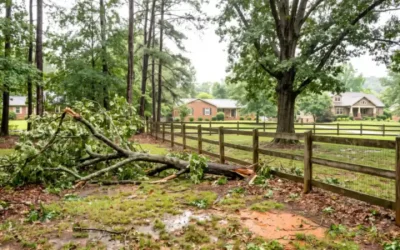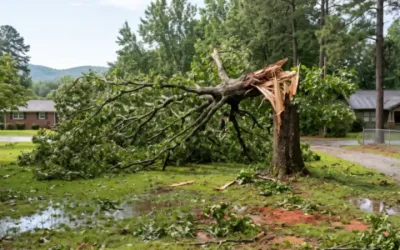
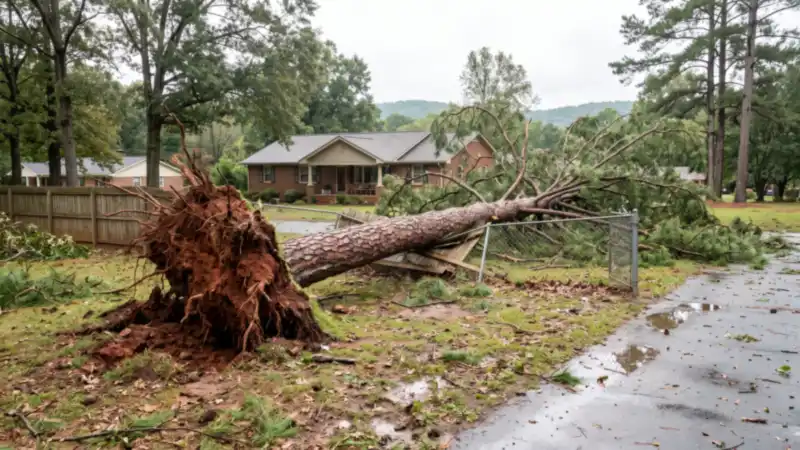
You went out this morning and noticed it: the oak that used to stand straight is now leaning toward the house, just slightly, just enough to make you stop and stare at it for a minute. A storm did that overnight, and now you’re stuck wondering if it’s going to fall the rest of the way or if it’s actually fine once the ground dries out. A leaning tree removal Pelzer SC homeowners search for after a storm is usually about answering that exact question, and the fastest way to get a real answer is a call to 864-232-8194.
Why a New Lean Is Different From an Old One
A tree that leans the same way it always has usually isn’t a sign that something new has gone wrong. A tree that started leaning after a storm, or whose lean visibly worsened, is a different situation entirely, since that kind of sudden change often means the root system has already partially failed.
Heavy rain softens soil and loosens the grip roots have on the ground. A tree can hold itself upright for years on root structure that’s slowly weakening, and a single storm with saturated ground and strong wind can be the event that tips it past the point where it can hold on. The lean you’re seeing this morning may be the tree telling you it’s already lost that fight, even if the trunk and canopy still look healthy from a distance.
The direction of the lean matters too. A tree leaning away from the house, toward open yard, carries a different level of urgency than one leaning toward the roof, a parked car, or a neighboring property. Both situations deserve a look, but one of them changes what’s at risk if the tree keeps moving.
Pay attention to how the tree reacts the next time wind picks up, even a mild gust. A tree with a stable root system will sway a little at the canopy but stay planted at the base. A tree with compromised roots sometimes shows motion at the base itself, a subtle rocking where the trunk meets the ground, which is a stronger warning sign than canopy movement alone.
What to Check Before You Decide
A few specific signs can help you figure out whether a leaning tree needs to come down now, needs monitoring, or might be fine. Here’s what to look for around the base of the tree before making that call.
- Soil that’s visibly heaved, cracked, or lifted on one side of the trunk, which often means roots on that side have pulled loose
- Exposed roots that weren’t visible before the storm, suggesting the root plate has shifted
- A gap or small trench forming at the base where the trunk meets the ground, even a few inches
- Cracking sounds from the trunk or major limbs when wind picks up again
- Whether the lean has measurably increased since you first noticed it, which you can track by photographing it from the same spot every day or two
- How close the tree stands to the house, a fence, a parked vehicle, or a neighbor’s property line
Any one of these signs on its own is worth a closer look. Several of them together, especially heaved soil paired with a lean that’s getting worse, usually means the tree has already lost enough root support that waiting isn’t a safe option.
It helps to rule out the simple explanations first too. A tree that’s always grown at a slight angle toward more sunlight, common in a crowded tree line, isn’t the same thing as one that shifted overnight. Knowing which pattern you’re looking at before anyone shows up can help you describe the situation clearly over the phone.
Why Franklin Tree Service Looks at the Whole Picture, Not Just the Lean
A leaning tree removal Pelzer SC decision should come from someone examining the root base, the soil condition, and the direction and degree of the lean together, not from a glance at the trunk from the driveway. Franklin Tree Service checks all of that before recommending removal, cabling, or simply continuing to watch the tree over the following days.
Not every leaning tree needs to come down immediately. Some have leaned the same way for years without any root disturbance and are structurally sound. Others look fine from a distance but have already lost the root support that was holding them up, and that distinction only shows up with a direct look at the base and the surrounding soil.
Storms affect trees across Pelzer and the surrounding area differently depending on soil type, drainage, and how exposed a property is to wind. A tree on a hillside lot with poor drainage faces different pressure than one in a sheltered, well-drained yard, and that context matters when deciding how urgently a leaning tree needs attention.
Don’t Wait to Find Out Which Kind of Lean You Have
A tree that’s already leaning toward your house isn’t going to answer the question for you by standing still. Every day it stays untouched is another chance for the next round of wind or rain to finish what the last storm started.
The tree removal team at Franklin Tree Service can look at the lean, the roots, and the soil around your tree and tell you exactly what’s going on, along with help from the storm damage cleanup crew if other trees or debris need attention too. Call 864-232-8194 and get a real answer before the next storm rolls through.